

Buying Guide
Adjustable Dumbbells for Women: A Fit-First Buying Guide
Oct
Adjustable Dumbbells for Women: A Fit-First Buying Guide
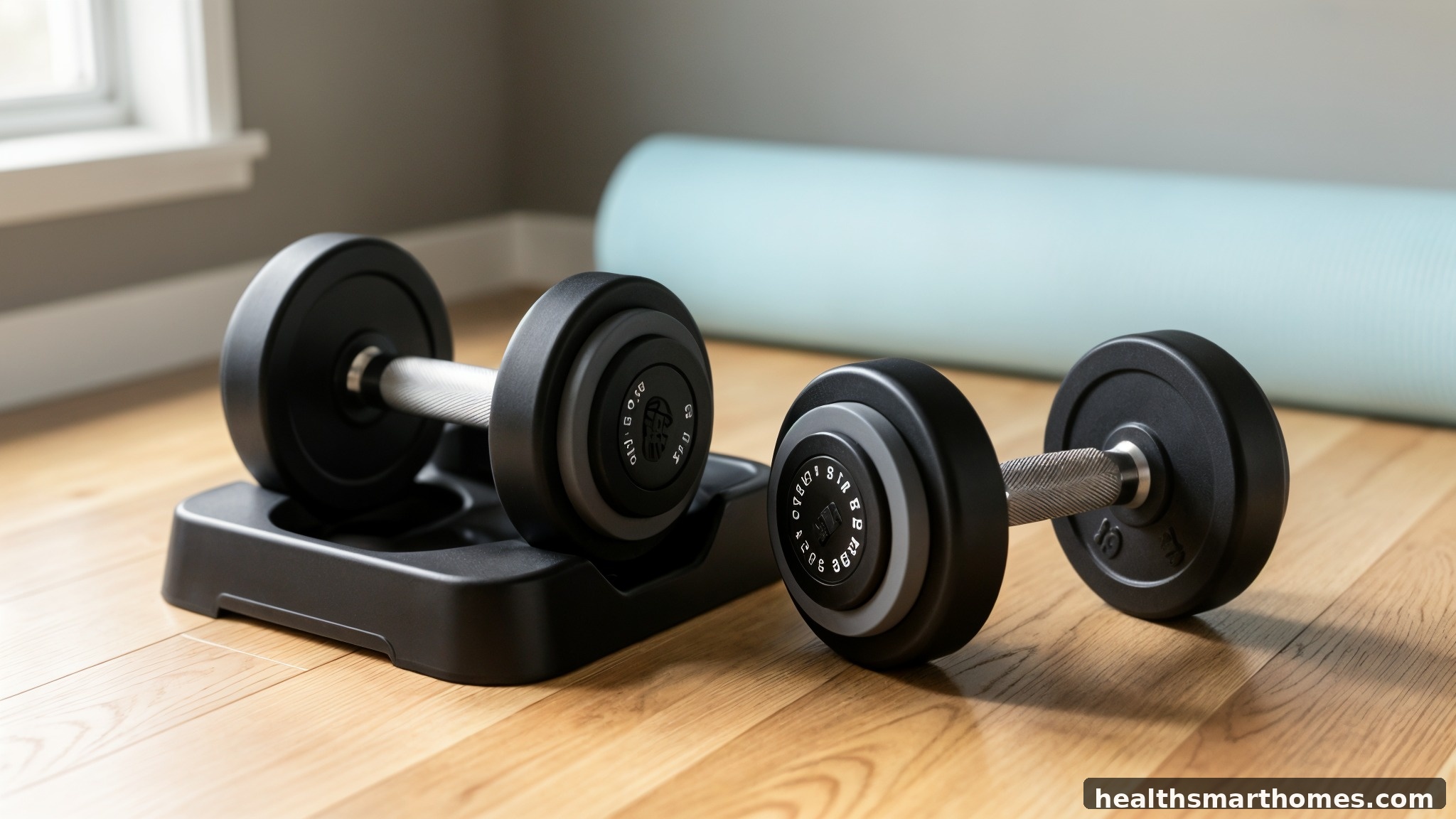
Adjustable dumbbells for women are one pair of dumbbells that replaces a rack by changing weight in fixed steps. “For women” is a marketing label, not an engineering spec: fit comes down to starting weight, the jump between settings, handle diameter and length at light loads.
Most adjustable dumbbell reviews are written around the heaviest lifter in the room, so the numbers that matter for a first home setup get buried: what the dumbbell weighs at its lowest setting, how big the jump is to the next one, and whether the thing clears your hips on a curl. This guide works backwards from those numbers. If you are shopping for adjustable dumbbells for women and want a set you will still be using in two years, the four measurements below decide more than any label on the box.
Why “for women” is a label, not a specification
No manufacturer publishes a women’s engineering standard for dumbbells. The weight range, the adjustment mechanism, the plate materials and the grip are model-specific, and the same set is sold to every buyer. A representative example is the Bowflex SelectTech 552, which uses steel plates coated in polypropylene with molded nylon, ABS and thermoplastic-rubber parts, including a rubber handle grip.
That matters because a “women’s” badge on a product page usually signals color, lighter starting weights or a smaller bundle, not a different mechanism. Two shoppers with the same hand size and the same program should buy the same set regardless of gender. What actually separates a good purchase from a frustrating one is the set of physical numbers covered next.
The four numbers that decide whether a set fits
1. Starting weight and the smallest jump
A set that begins at 5 lb per dumbbell is a very different tool from one that begins at 10 lb. Light isolation work, shoulder rotations and rehab-style movements need a low floor, and a 10-lb minimum has been flagged as limiting for some shoulder-rotation exercises. Reviewers also note that 2.5-lb steps are preferable at lighter loads, because a 5-lb jump is a large percentage increase when you are pressing 15 lb.
Check both figures before you buy: the lowest setting and the gap between consecutive settings. A wide range with coarse steps can still be the wrong set for someone in their first six months of training.
2. Length at the weights you use most
Selector dumbbells stay long even when they are light. That extra length shows up on curls, lateral raises and any movement that brings the weight close to the body, and longer bars are harder to manage for smaller-framed lifters. A 16.9 in dumbbell and a 10 in dumbbell hold similar loads but feel completely different at rep ten.
Measure the dumbbell at the setting you will use most, not just at its maximum. If the ends bump your thighs at the bottom of a curl, the set is the wrong shape for you no matter how good its spec sheet looks.
3. Handle diameter and clearance
Grip diameter is the specification manufacturers most often leave out. A thicker handle tires smaller hands faster, and some owners report that the Bowflex SelectTech 552’s grip feels large while its wide ends bump the forearms or chest during certain movements. A general sizing reference puts the gap between the heads of a typical fixed dumbbell at roughly 4.9-5.3 in (125-135 mm).
Manufacturers do not publish an equivalent clearance figure for adjustable models, so the only reliable test is your own hand and a return policy. Where a grip diameter is listed, compare it to a dumbbell you already own. Where it is not, plan to try the set or buy from a seller who accepts returns.
4. Footprint and storage
Every selector set ships with a cradle or tray, and that tray is the real storage requirement in a small apartment or a shared room. The compact end of the market runs around 10 in long, while high-capacity sets run 17.5 in. Add the tray width and the space you need to sit the dumbbell back down cleanly.
Re-racking is part of the workout. Reviews mention cradles that need careful alignment and one tested model whose cradle could stick at heavier settings, so budget for a little floor space in front of the tray rather than jamming it against a wall.
Four models, compared on the numbers that matter
The table below uses manufacturer-published dimensions and weight ranges. Prices move constantly and vary by retailer, so they are deliberately left out.
| Model | Range per dumbbell | Settings and increments | Dimensions (L x W x H) |
|---|---|---|---|
| PowerBlock Sport 24 | 3-24 lb | Not published in the sources reviewed | 10 x 5.5 x 5.5 in |
| PowerBlock Pro 50 | 5-50 lb | Not expandable | 13 x 7 x 7.25 in |
| Bowflex SelectTech 552 | 5-52.5 lb (2.3-23.9 kg) | 15 settings; 2.5 lb steps to 25 lb, then 5 lb steps | 16.9 x 8.3 x 9 in |
| Bowflex SelectTech 1090 | 10-90 lb | Not published in the sources reviewed | 17.5 x 9.5 x 10 in |
The spread is the point. The Sport 24 gives a 3 lb floor in a 10 in body, which suits light upper-body work and small storage. The SelectTech 1090 gives a 90 lb ceiling but starts at 10 lb and measures 17.5 in, so it is a poor first set for someone who is not yet pressing 20 lb.
Quotable: Bowflex lists the SelectTech 552 at 5-52.5 lb (2.3-23.9 kg) per dumbbell across 15 settings, using 2.5 lb steps through 25 lb, then 5 lb steps through 50 lb, plus a final 2.5 lb step to 52.5 lb.
Quotable: Bowflex cautions that manufacturing tolerances can make the actual weight at a given setting vary from the stated value, so a “20 lb” setting is a nominal figure rather than a calibrated one.
Quotable: The PowerBlock Sport 24 measures 10 x 5.5 x 5.5 in and spans 3-24 lb per dumbbell, while the Pro 50 measures 13 x 7 x 7.25 in and spans 5-50 lb and is not expandable.
How to test a set before you commit
- Find the lowest setting and the smallest jump. Write both numbers down. If the floor is above the weight you curl, the set is not for you yet.
- Set it to the weight you use most and check the length. Hold it at the bottom of a curl. If it contacts your thigh or hip, try a shorter model.
- Grip it for 30 seconds. Handle diameter is often unpublished, so your hand is the only spec sheet you have. Compare against a dumbbell you already like.
- Set, lift and re-rack three times at different weights. Confirm the selector engages cleanly and that the dumbbell drops back into its cradle without wrestling.
- Read the manual’s adjustment rules. Follow the manufacturer’s adjustment instructions and change settings while the dumbbell is seated in its cradle, since dial systems can be damaged by turning the selector with the handle out of the cradle.
What materials do and do not tell you
In a selector dumbbell the steel plates and the metal connections carry the load; polymer coatings and molded parts separate and protect components, and the grip material affects handling. Those descriptions do not establish service life, drop resistance or a safe overload limit.
Nor do they establish certification. The sources reviewed do not show that these models are certified to a dumbbell-specific durability or load standard, and a passing mention of “ASTM” on a retailer page or a blog is not evidence of compliance. If standards compliance is a requirement for you, ask the manufacturer for the exact standard, its edition, and a test report for that specific model.
Treat the published weight range as a rated selectable weight, not a drop rating. Do not drop a loaded adjustable dumbbell; the mechanism that makes it adjustable is also the part that fails first.
Picking the right set for your stage
Starting out, training at home a few times a week: a set with a 3-5 lb floor and 2.5 lb steps covers presses, rows, curls and lateral raises for a long time. The PowerBlock Sport 24 adjustable dumbbell pair (3-24 lb) is the compact option in that bracket, at 10 in long.
Already squatting and pressing bodyweight: you need headroom past 50 lb per hand, and a set that does not force a 10 lb jump at the bottom. The BowFlex SelectTech 1090 single dumbbell (10-90 lb) covers that ceiling, but note it is sold as a single dumbbell and starts at 10 lb, so it suits a lifter who is already strong at the light end.
Whichever way you go, buy the bench next rather than the next pair of dumbbells. A flat bench unlocks presses, rows and split squats that a floor and a pair of dumbbells cannot, and our weight bench collection lists current models with their load ratings. If you want the comparison work done for you, start with our guide to the best weight benches for home gyms in 2026.
Two solid starting points are the flat weight bench for strength training and the height adjustable flat weight bench, both of which pair naturally with a dumbbell-only program. Browse the full fitness equipment range if you are fitting out a room rather than a corner.


Frequently asked questions
Are adjustable dumbbells actually worth it for women?
Yes, when the set matches your starting strength. One pair replaces a rack of fixed dumbbells and takes up roughly the floor space of a shoebox. They stop being worth it if the lowest setting is too heavy or the dumbbell is too long for the movements you do most.
What weight should a beginner woman start with?
There is no universal number, and any article that gives one is guessing. Work from the exercises you plan to do: lateral raises and shoulder rotations need a much lighter load than rows or split squats. Pick a set whose floor sits below your lightest working weight.
Do adjustable dumbbells fit smaller hands?
Sometimes, and the spec sheet often will not tell you. Grip diameter is frequently unpublished, thicker handles tire smaller hands faster, and wide ends can bump the forearms during pressing. Try the handle in person where possible, or buy from a seller with a return window.
Can I drop adjustable dumbbells after a set?
No. The published weight range is a rated selectable weight, not a drop rating, and the selector mechanism is the most fragile part of the product. Change settings only while the dumbbell is seated in its cradle and follow the manufacturer’s adjustment instructions.
Is a 5 lb jump too much between settings?
For light upper-body work it often is. Reviewers note that 2.5 lb steps are preferable at lighter loads, because 5 lb is a large percentage increase on a 15 lb press. If your program lives in that range, prioritize a set with finer increments.
The short version
Skip the label and shop four numbers: the lowest setting, the smallest jump, the length at your working weight, and the handle diameter. A set that starts light, steps finely and stays short will serve a beginner far better than a 90 lb model that starts at 10 lb and measures 17.5 in.
Then put the money you saved into a bench, because dumbbells alone leave the best pressing and rowing angles on the table. Our fitness and strength equipment pages are the place to see what is currently in stock.
Written by the healthsmarthomes.com editorial team. Specifications were taken from manufacturer product pages and owner manuals; retailer prices move too often to publish here. If you spot an error or a spec that has changed, contact us through our site and we will correct it.
