

Buying Guide
Bounce Pro 14ft Trampoline: Real Specs & Weight Limits
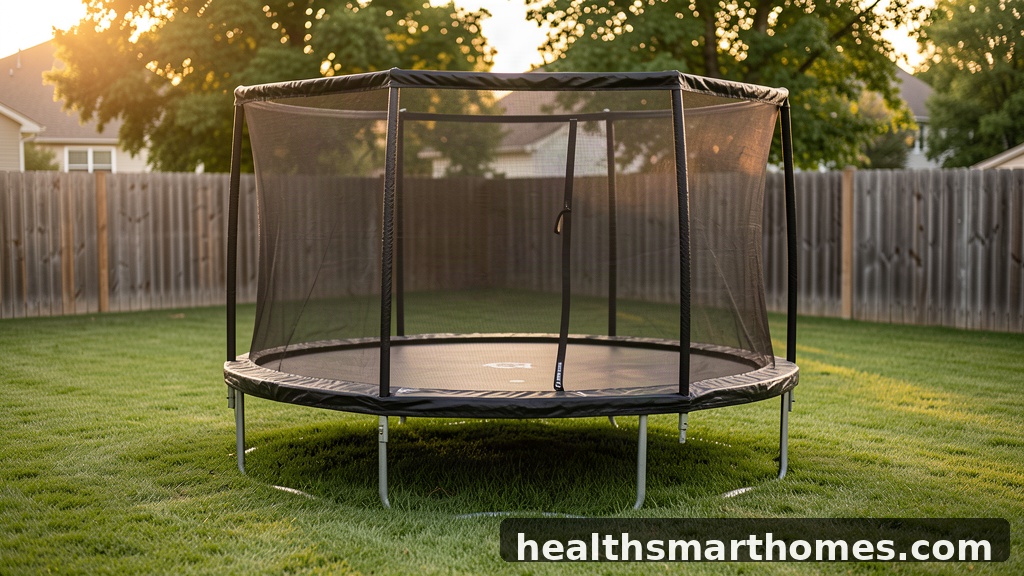
Oct
Bounce Pro 14ft Trampoline: Real Specs & Weight Limits
Definition: The Bounce Pro 14ft trampoline is a round backyard trampoline from Sportspower whose 14 ft (168 in / 426.7 cm) measurement describes the outside frame diameter, not the clear jumping surface. Standard models list a 220 lb (100 kg) single-jumper weight limit.
If you are shopping for a Bounce Pro 14ft trampoline, you are probably standing in front of a Walmart or Sam’s Club listing wondering what the model number on the box actually gives you. The headline numbers are easy to misread: 14 ft sounds like 14 feet of bouncing room, and the weight figure quoted in reviews is sometimes a frame test load rather than something a person may put on the mat. This guide separates the two.
Trampoline and home fitness safety: standards and official guidance(Trampoline / home fitness equipment safety standards and official guidance – non-federal) · verified 2026-10-18
Trampoline safety in the US is split between a voluntary engineering standard and federal guidance – there is no mandatory national trampoline rule. Below is what a product listing is claiming to meet, and where an official recall would appear.
| Standard / guidance | Citation | Source |
|---|---|---|
| Consumer trampolines (ASTM) | ASTM F381-24 (voluntary standard) | official text |
| Trampoline safety (CPSC) | CPSC safety guidance | official text |
| Exercise equipment recalls (CPSC) | CPSC recall database | official text |
Three checks before you assemble it
- Trampolines: ASTM F381 is a VOLUNTARY standard (not federal law) – it covers enclosure, padding, labelling and assembly.
- CPSC publishes safety guidance and recall notices rather than a mandatory trampoline rule; check the model against the recall database.
- Home fitness equipment has no single federal standard: check the recall database and the manufacturer’s stated user-weight limit.
Reference only, not legal advice. ASTM standards are voluntary unless a jurisdiction adopts them; CPSC material here is guidance and recall data, not a mandatory rule.
Federal baseline: CPSC publishes trampoline safety guidance and recall notices rather than a binding trampoline regulation, and ASTM F381 is voluntary unless a state or local jurisdiction adopts it by reference.
Below you get the measured footprint from Sportspower’s own listings, the weight limits for the versions that are actually sold, the materials named in the product documentation, the mistakes owners report after assembly, and the recall check worth running before you inflate a single spring.
What the “14ft” measurement actually covers
The 14 ft figure is the trampoline’s overall diameter, and the assembled listing measurements show what that means in a yard: 14 x 14 x 9.5 ft, or 168 x 168 x 114 in, on the standard model. A Flash Lite Zone version is listed at 14 x 14 x 9.2 ft (168 x 168 x 110.4 in), so even the height changes between versions that share the same 14 ft badge.
None of the listings we checked publish a clear-mat diameter, which is the number that decides how much room a child actually has to land. The frame, spring area and padding all sit inside that 168-inch circle, so treat “14 ft” as an envelope and the mat as something smaller.
Bounce Pro 14ft specs by version
| Spec | Standard 14 ft | 14 ft Flash Lite Zone | Sam’s Club heavy-duty 14 ft |
|---|---|---|---|
| Assembled size | 168 x 168 x 114 in (14 x 14 x 9.5 ft) | 168 x 168 x 110.4 in (14 x 14 x 9.2 ft) | Not stated in the listing |
| Outside diameter | 168 in (426.7 cm) | 168 in (426.7 cm) | 168 in (426.7 cm) |
| Max user weight | 220 lb (100 kg), one jumper | 220 lb (100 kg), single user | 250 lb (113.4 kg) |
| Frame test load | Not stated | 1,200 lb (544 kg) | Not stated |
| Jump mat | TenCate Permatron, UV-tested beyond 5,000 hours | 5,000+ UV-hour claim, fabric not identified | Not stated |
| Enclosure | UV-resistant polyethylene netting, padded spring cover | UV-resistant net, 5,000+ hour claim | Safety net with basketball system |
| Standards claim | “Meets ASTM safety standards” (no number, edition or report) | Same claim, plus a Bureau Veritas testing mention | Same claim |
The pattern in that table is worth pausing on: the same product name ships with at least three different weight limits and two different assembled heights. Check the model number on the carton, not the brand name in the search bar.
How much yard does a 14 ft trampoline need?
Plan for the 168-inch frame plus walking room around it, and take the required clearance from the manual that ships with your specific model rather than from a general rule. Sportspower’s own listings do not publish a clearance distance, so the manual is the only authoritative source for the version you buy.
For placement, enclosure and supervision questions, the CPSC trampoline safety guidance is the official reference: it collects the agency’s advice and links to recall data, and it is guidance rather than a binding federal rule. Pair it with your manual, which is the document a manufacturer can actually be held to.
A 14 ft Bounce Pro occupies a 168 in (426.7 cm) circle before clearance, and the standard model stands 114 in (9.5 ft) tall at the enclosure — so an 11 ft ceiling, a low fence line or a tree limb will decide the site before the diameter does.
Weight limits: 220 lb standard, 250 lb Sam’s Club
Most Bounce Pro 14 ft listings state a 220 lb (100 kg) maximum for one jumper at a time. The Sam’s Club heavy-duty version with the basketball system is listed at 250 lb (113.4 kg). Those two figures describe different products, so a review quoting one is not evidence about the other.
Why the 1,200 lb figure is not a user limit
Some Flash Lite Zone listings state that the frame was tested to 1,200 lb (544 kg). That is a structural test number for the frame under load, not permission for a heavier person or for two children at once. Using a test load as a user limit is the single most common spec misread on this model, and it is the kind of number that reads as reassurance while actually saying nothing about the mat or the springs.
If your household is over 220 lb
Take the 250 lb version if you can find it in stock, and compare advertised limits across models instead of assuming all 14-foot trampolines are rated alike. If you need a higher ceiling than that, a larger or adult-oriented model is the honest answer rather than a 14 ft frame pushed past its stated limit.
Build quality: what the listings do and don’t document
The manufacturer descriptions are specific about some components and silent about others, which matters when you are comparing a $200-something retail model against premium brands. Here is what is documented, and what is not.
Frame and legs
Galvanized, rust-resistant steel is named on the 14 ft versions, with some listings adding thick-gauge tubing, double-welded joints and U-shaped legs. Those are construction and corrosion-resistance claims, not a published service life, so read them as material descriptions rather than a durability guarantee.
Mat, net and spring cover
The classic 220 lb model names a TenCate Permatron mat, UV-tested for more than 5,000 hours, with UV-resistant polyethylene netting and a padded spring cover. The newer Flash Lite version repeats the 5,000+ hour UV claim without identifying the mat fabric, and no 14 ft listing publishes a spring grade or a spring-cycle test.
The ASTM claim problem
Listings say the trampoline “meets” or “meets or exceeds” ASTM safety standards, but the descriptions we reviewed do not name the standard number, edition, test report or certificate, and the Bureau Veritas mention on one listing is not linked to a report. Ask the seller for the certificate if the standards claim is part of why you are buying — a claim without a report number cannot be checked.
What owners report after assembly
Owner reviews on these models cluster around a handful of fit problems rather than defects, and knowing them in advance saves an afternoon.
- Assembly is a two-person job. Reviewers commonly estimate roughly 1–3 hours, and both The Trampoline Mom and Walmart reviewers describe a roughly two-hour, two-person setup. Springs and net are the slow parts.
- Parts are model-specific. Enclosure poles, legs and nets vary between versions, so match the model number and part number before ordering a replacement.
- Wind protection is not optional. Owners report unsecured trampolines moving or flipping in strong wind and bending enclosure poles; ground anchors are the fix they recommend.
- The bounce feel divides people. Some describe the mat as saggy or stiffer near the edges. That is a preference issue reported inconsistently, not a universal defect — compare spring count and length if a lively bounce matters to you.
- Check the box, then the accessory list. A ladder is not included on at least one version, and some buyers report damaged packaging or loose parts on delivery.
Replacement parts worth pricing before you buy
Because parts are version-specific, price the pieces you are most likely to lose before you commit. Two examples sold on Amazon show the shape of the problem: a Bounce Pro 14′ round trampoline vertical leg extension (6A) and a lower enclosure pole that fits many Bounce Pro models — note the “many”, not “all”. Measure the old part and check the model number before ordering either.
Check the recall before you buy — especially used
A 2012 recall covered certain older 14-foot Bounce Pro trampolines with brown enclosure mesh, sold from February 2009 through February 2012. Owners of those units were advised to stop using them and request replacement black mesh. If you are buying secondhand, or if a brown-mesh trampoline is already in your yard, confirm the model and production period before anyone jumps.
This is the one check that a spec sheet cannot do for you: a used 14 ft Bounce Pro can look structurally perfect and still fall inside the recall window. Photograph the model plate and the mesh colour, then compare against the recall notice.
Bounce Pro 14ft vs the alternatives
The 14 ft size is the sweet spot for a family with primary-school-age children and a yard that cannot take a 16-footer, and the Bounce Pro is priced accordingly. If you want to compare within the size class first, our roundup of the best round outdoor trampolines puts the 14 ft options side by side, and the 16ft trampoline with net guide covers what the next size up buys you.
Two directions are worth considering before you buy the spring version. A no-gap design removes the spring-and-pad zone entirely, which is the area where most landing injuries on traditional trampolines happen; the 14ft springfree no-gap trampoline is the direct comparison. And if you want the enclosure and ladder bundled rather than bought separately, the 14ft trampoline with enclosure net and ladder covers that configuration, while the plain 14FT trampoline is the bare-frame option.


Either way, measure the site first: a 168-inch circle plus clearance, plus the 114-inch enclosure height, is what has to fit. Our full trampoline range lets you filter by size once you know the number.
Frequently asked questions
What is the actual jumping area of a Bounce Pro 14ft trampoline?
Bounce Pro does not publish a clear-mat diameter for the 14 ft models. The 14 ft (168 in / 426.7 cm) figure is the outside frame diameter, and the frame, springs and padding sit inside it, so the usable mat is smaller than 168 inches across.
What is the weight limit on a Bounce Pro 14ft trampoline?
Standard 14 ft models are listed at 220 lb (100 kg) for one jumper at a time. The Sam’s Club heavy-duty version with a basketball system is listed at 250 lb (113.4 kg). The 1,200 lb (544 kg) figure on some listings is a frame test load, not a user limit.
How long does a Bounce Pro 14ft trampoline take to assemble?
Reviewers typically report roughly 1–3 hours, with two adults doing the work. The springs and the enclosure net take most of that time. Budget an afternoon, lay the parts out first, and check the carton for missing pieces before you start.
Are Bounce Pro 14ft trampoline parts interchangeable between versions?
No — not reliably. Enclosure poles, leg extensions and nets are model-specific, and listings for Bounce Pro parts warn that some fit only certain models. Match the model number and part number, and measure the old component, before ordering a replacement.
Is the Bounce Pro 14ft trampoline ASTM certified?
Listings claim the trampoline meets ASTM safety standards but do not name the standard number, edition or test report, and one mentions third-party testing without linking a certificate. Treat “meets ASTM” as a marketing claim until the seller supplies a report you can read.
The short version
A Bounce Pro 14ft trampoline gives you a 168-inch frame, a 220 lb (100 kg) single-jumper limit on the standard version, a 250 lb limit on the Sam’s Club heavy-duty model, and an enclosure that stands about 9.5 ft. Confirm the model number, confirm the weight rating on that exact model, and run the recall check if the unit is used or older.
If those numbers fit your yard and your family, the next step is comparing enclosure, ladder and springfree configurations side by side in our trampoline collection — and if the footprint is too big, size down through the round trampoline roundup before you buy.
