

Buying Guide
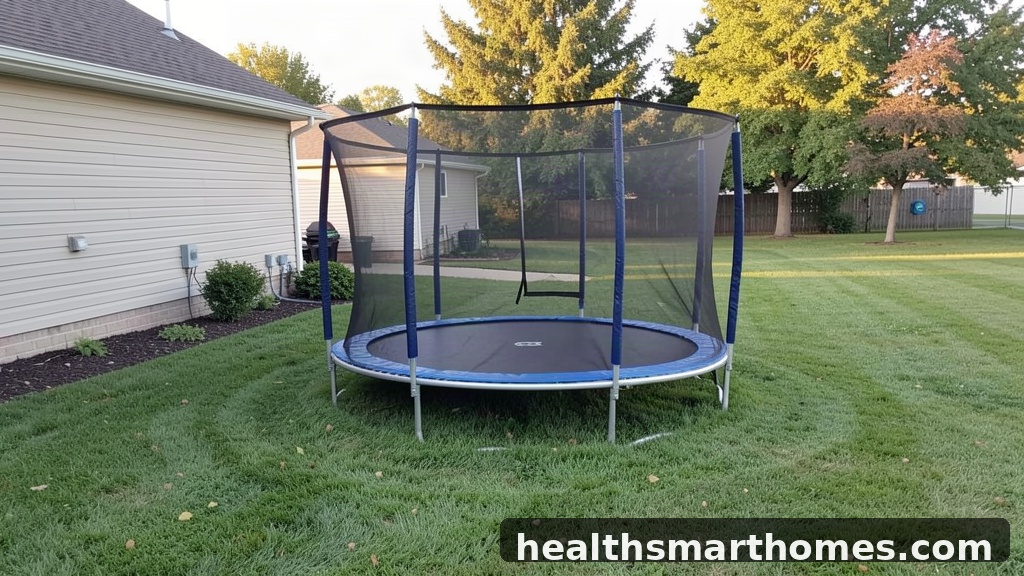
How Close Can You Place a Trampoline to a House?
Oct
How Close Can You Place a Trampoline to a House?
Definition: Trampoline-to-house clearance is the open ground between the outside edge of the assembled frame and enclosure and the nearest wall, eave, fence or tree. Manufacturer guidance commonly asks for 5 ft of clear space around the perimeter, Health Canada asks for 2 m (6 ft 7 in), and the model’s manual outranks both.
How close can you place a trampoline to a house safely? The honest answer is that no US federal rule gives you a number in feet. What exists is manufacturer spacing guidance that starts at 5 ft of clearance around the perimeter, Health Canada’s 2 m (6 ft 7 in) recommendation, a voluntary ASTM specification covering the equipment rather than the site, and a growing pile of insurance claims filed by people who measured the trampoline and forgot the roof. This guide walks the measurement the way you would actually do it in a backyard, with the numbers labelled by where they come from.
Trampoline and home fitness safety: standards and official guidance(standards and official guidance checked at source (non-federal) · verified 2026-10-18)
Trampoline safety in the US is split between a voluntary engineering standard and federal guidance – there is no mandatory national trampoline rule. Below is what a product listing is claiming to meet, and where an official recall would appear.
| Standard / guidance | Citation | Source |
|---|---|---|
| Consumer trampolines (ASTM) | ASTM F381-24 (voluntary standard) | official text |
| Trampoline safety (CPSC) | CPSC safety guidance | official text |
| Exercise equipment recalls (CPSC) | CPSC recall database | official text |
Three checks before you assemble it
- Trampolines: ASTM F381 is a VOLUNTARY standard (not federal law) – it covers enclosure, padding, labelling and assembly.
- CPSC publishes safety guidance and recall notices rather than a mandatory trampoline rule; check the model against the recall database.
- Home fitness equipment has no single federal standard: check the recall database and the manufacturer’s stated user-weight limit.
Reference only, not legal advice. ASTM standards are voluntary unless a jurisdiction adopts them; CPSC material here is guidance and recall data, not a mandatory rule.
Federal baseline: CPSC publishes trampoline safety guidance and recall notices rather than a binding trampoline regulation, and ASTM F381 is voluntary unless a state or local jurisdiction adopts it by reference.
You will get the clearance figure that governs your model, a footprint table for the six sizes sold most often, the overhead check most owners skip, and the ground and anchoring rules that decide whether a spot beside the house is genuinely usable or just wide enough on paper.
The short answer: 5 to 6 feet of clear ground, measured around the perimeter
Start with the manufacturer’s rule, because it is the one with published numbers behind it. Springfree’s own sizing guidance recommends a minimum of 5 ft of clearance around the perimeter and gives the shortcut: add 10 ft to the model’s length and width. Its published spacing table follows that rule exactly, from 16 ft of space for a 6 ft model through 18 ft for an 8 ft model and 20 ft for a 10 ft model. Health Canada’s guidance is more conservative at 2 m (6 ft 7 in) per side, and your model’s manual outranks both.
Springfree publishes the clearest spacing rule available to a buyer: a minimum of 5 ft of clearance around the perimeter, calculated by adding 10 ft to the trampoline’s length and width, so an 8 ft round model needs 18 ft of clear space and a 10 ft model needs 20 ft.
The clearance is air space, not footprint. Springfree makes that distinction explicit for its 11 ft square model, which needs 21 ft of clear space while still occupying 11 ft of ground. That is the difference between the measurement on the carton and the measurement that decides whether the spot works.
Two things then take priority over any round number. The first is your manual: it is the only document that carries the clearance the manufacturer can be held to, and models with taller enclosures or wider pads often ask for more. The second is the surface you would land on. A net keeps a jumper from leaving the mat in normal use; it does not turn a wall into a soft landing, and it is not designed to stop a fall from the frame or a bounce off the padding.
The official US reference for the surrounding advice is the CPSC trampoline safety guidance, which is guidance and recall data rather than a binding rule. It repeats the same theme as the manufacturer instructions: keep the trampoline away from structures, trees and other hard obstacles, and let one jumper on at a time.
Why the wall sets the number, and the fence does not
A fence line is usually the limit people plan around, but a house is a different kind of obstacle. It is taller than the enclosure, it has a roof edge that projects into the space above the trampoline, and it produces a hard, unforgiving surface at the exact height a jumper’s body occupies when they leave the mat at an angle.
There is also the practical side that has nothing to do with bouncing. A trampoline pushed hard against a wall leaves no walking room for an adult to reach a child who is hurt or stuck, no space to get a ladder in when the enclosure needs re-zipping, and no route for a mower or a leaf blower. Five or six feet is not generous when you use it for all three jobs at once.
No federal rule sets a universal house-to-trampoline distance: ASTM F381-24 is a voluntary specification for the components, assembly, use and labeling of consumer trampolines, and the clearance for the site you are standing in comes from the manual for that model.
ASTM’s own scope note on that standard is worth quoting to anyone who assumes a compliant trampoline is a safe trampoline: the specification covers components, assembly, use and labeling, and it states that compliant trampolines are not recommended for children under six.
Add the clearance to the real footprint before you buy
Advertised sizes describe the frame diameter. The clear width you need is that diameter plus the clearance on both sides. The table below runs that arithmetic for the sizes sold most often in the US, with a 5 ft column matching published manufacturer spacing and a 2 m column following Health Canada.
| Nominal size | Assembled frame diameter | Clear width at 5 ft each side | Clear width at 2 m each side (calculated) |
|---|---|---|---|
| 8 ft | 96 in (244 cm) | 216 in (18 ft) – matches the published R54 figure | 254 in (21 ft 2 in) |
| 10 ft | 120 in (305 cm) | 240 in (20 ft) – matches the published R79 figure | 278 in (23 ft 2 in) |
| 12 ft | 144 in (366 cm) | 264 in (22 ft) | 302 in (25 ft 2 in) |
| 13 ft | 156 in (396 cm) | 276 in (23 ft) – matches the published R132 figure | 314 in (26 ft 2 in) |
| 14 ft | 168 in (427 cm) | 288 in (24 ft) | 326 in (27 ft 2 in) |
| 16 ft | 192 in (488 cm) | 312 in (26 ft) | 350 in (29 ft 2 in) |
The three manufacturer figures in that table are not estimates: Springfree publishes 18 ft of required space for its 8 ft model, 20 ft for its 10 ft model and 23 ft for its 13 ft model. The rest of the column follows the same add-10-ft rule that produces those numbers, and the last column is arithmetic on Health Canada’s 2 m figure.
Read the third and fourth columns against the strip beside your house and the answer usually becomes obvious. A 16 ft trampoline wants 26 ft of clear width on manufacturer guidance and 29 ft under the 2 m rule, which puts it in the open yard rather than the gap between the wall and the fence. An 8 ft model needs 18 ft on manufacturer guidance and about 21 ft if you follow the metric figure, so it is the size that has a chance of working in a narrow side yard.
Measured against specific models, the numbers get more concrete. Our Bounce Pro 14 ft spec breakdown records an assembled size of 168 x 168 x 114 in (14 x 14 x 9.5 ft), so the enclosure alone reaches 9.5 ft, well above a single-storey eave on many homes. If the spot you have in mind is tight on width, the 8 ft Springfree size and setup guide covers the smaller end of the market, and the round outdoor trampoline roundup compares the sizes that dominate backyards.
Overhead clearance: the check that decides the spot
Look up from each corner rather than from the middle. Roof overhangs, gutter lines, low branches, washing lines, satellite dishes and service drop cables all sit inside the overhead zone, and the enclosure on a large round model already stands close to the height of a single-storey wall.
Health Canada’s backyard trampoline guidance names 8 m (26 ft 3 in) of clear overhead space and says to keep a trampoline clear of buildings and other hazards. Twenty-six feet is roughly the height of a two-storey house, so if your trampoline has to sit within a few feet of the wall, the roofline is what actually limits you, not the fence.
Health Canada asks for 8 m (26 ft 3 in) of clear overhead space, roughly the height of a two-storey house, which is why a spot beside a wall can fail on height while the ground distance still looks acceptable.
Walk the perimeter with the enclosure up and look up from each corner, not from the middle. The corners are where the enclosure poles stand and where an adult lifting a child over the pad will be working.
Ground rules: level, draining and not concrete
Placement advice is consistent on the surface: level ground, soft grass or a suitable play surface, and drainage that moves water away from the frame. Concrete, asphalt and a patio slab are the surfaces to avoid, and a slope is worse than a tight fit because a frame that is not sitting level flexes unevenly every time someone lands off-centre.
A house wall usually comes with the opposite of drainage. The strip beside a building collects roof runoff, holds shade for most of the day, and stays damp long after the rest of the lawn has dried. Steel frames are commonly galvanised or powder-coated, which slows corrosion but does not make a frame immune to standing water at the leg bases. Inspect for rust, cracks, bent parts and loose joints before the season starts, not after something feels wobbly.
If the only level spot in the yard is the one beside the house, that is the moment to reconsider the size rather than the position. Going down a size keeps the clear zone intact; squeezing a larger model into the strip does not.
Anchoring, and why it matters more next to a building
A trampoline is a light, high-sided object with a large sail area, and the gap between a house wall and a fence forms a channel where wind speed climbs. Anchoring is a separate job from placement, and the manual for your model will tell you whether the frame is designed to be tied down and where the straps may attach.
Most US anchor kits use screw-in ground stakes with straps that hook over the frame; a four-point kit such as this trampoline anchor stake kit on Amazon is the common shape of the product. Use the anchor points the manual specifies, keep the straps clear of the springs, and check them after the first windy week rather than assuming they are set for the season.
Two limits are worth stating plainly, because both come up in reviews after a storm. Anchoring does not replace the clear zone, and a net does not stop the frame from lifting. If the manufacturer’s manual does not describe an anchoring method for your model, treat that as an unanswered question and ask the seller before you add hardware.
When the yard cannot give you the clearance
If your yard cannot fit 18 to 20 ft of clear width, the options below are the realistic ones, in order of how well they work:
- Downsize the model. Moving from a 14 ft to a 10 ft round cuts the required clear width from 24 ft to 20 ft on manufacturer guidance, or from about 27 ft to 23 ft under the 2 m figure, and the 10 ft trampoline with net buying guide covers what that size actually fits.
- Move it to the open part of the yard and accept a longer walk from the back door. Distance from the house is free; clearance is not.
- Check the weight rating before you shop by size. A smaller mat with a low user limit will not serve a teenager, and our outdoor trampoline guide for adults tracks the models rated to 450 lb.
- Decide it is not a good fit. If no position in the yard can hold the manual’s clear space, the safer answer is a different activity, not a padded compromise against the wall.
One number deserves a warning before you compare listings. A product’s jumper weight limit and its frame-load capacity are different figures, and only the first one describes a person. One listing cited in manufacturer documentation pairs a 330 lb jumper limit with a 1,650 lb frame-load capacity; quoting the second as if it were the first turns a small trampoline into an adult-rated one on paper.
Frequently asked questions
How close can a trampoline be to a house?
Manufacturer guidance commonly asks for 5 ft of clearance around the perimeter, and Health Canada’s figure is 2 m (6 ft 7 in) per side. Measure from the outside edge of the frame and enclosure, not the mat. Your model’s manual takes priority, and the overhead figure often rules out the spot regardless of ground distance.
Does a safety net mean I can place it closer to the wall?
No. A net is designed to keep a jumper on the mat during normal use, not to make a nearby wall a safe landing area. Placement guidance treats the surrounding space as needing to be free of structures and hard obstacles, and it applies whether or not the model ships with an enclosure.
How much space does a 14 ft trampoline need?
A 14 ft round trampoline has a 168 in (427 cm) frame, so with 5 ft of clearance on each side it needs about 288 in (24 ft) of clear width and depth, or 326 in (27 ft 2 in) under the 2 m figure. Check the model’s enclosure height against any eave as well.
Can a trampoline sit on a patio or concrete slab?
It is not recommended. Placement advice calls for level, soft ground with drainage away from the frame, and concrete or asphalt is the surface to avoid. A patio beside the house also concentrates runoff and shade, which is hard on the frame legs and the mat over a season.
Do I need to anchor a trampoline that sits beside the house?
Follow the manual first, then anchor if the model allows it. A gap between a house and a fence channels wind, and a trampoline is a large sail, so a four-point anchor kit with screw-in stakes is the usual precaution. Anchoring does not reduce the clear zone you still owe the wall.
The bottom line
Measure the assembled frame, add 5 ft (or 2 m if you follow Health Canada) on every side, then look up and check what a 26 ft overhead clearance would hit. If the answer is the roofline, the spot beside the house is out, whatever the width says. If you have the room, choose the size that leaves the clear zone intact rather than the largest model that physically squeezes in, and read the manual’s clearance and anchoring instructions before the carton is opened.
Once the position is settled, the buying decision is mostly about the model: frame size, enclosure height, user weight limit and the pad quality. Our round outdoor trampoline comparison sets those four side by side for the current season.
